|
Rensselaer Celebrates Grand Opening of World-Class Supercomputing Center
Event features presidential colloquy and highlights
partnership with IBM, New York state
Troy, N.Y. — In the true spirit of the computer age,
Rensselaer Polytechnic Institute today celebrated the grand
opening of the world’s most powerful university-based
supercomputer with a “virtual” ribbon-cutting ceremony.
The “physical” celebration, which was held on the Rensselaer
campus, began with a presidential colloquy involving five of
the country’s foremost leaders in science, technology, and
innovation. The colloquy was followed by a “virtual” grand
opening via video link to the Rensselaer Technology Park, where
the primary elements of the supercomputer are housed.
The Computational Center for Nanotechnology Innovations
(CCNI), the result of a $100 million partnership involving
Rensselaer, IBM, and New York state, was recently ranked
seventh in the world, and it is the most powerful of any system
based exclusively at a university, according to the 29th
edition of the closely watched Top500 list.
“This new supercomputing center will provide unprecedented
opportunities for the Rensselaer community, the Capital Region,
the United States, and indeed the entire world,” said
Rensselaer President Shirley Ann Jackson. “It is an
extraordinary example of collaboration among academia,
industry, and government to advance discovery and innovation. I
am grateful for the shared vision of our partners as we work
together to explore new frontiers in supercomputing.”
“The supercomputer is yet another example of the positive
synergy that is created when government, higher education, and
the private sector work together,” said New York State Senate
Majority Leader Joseph L. Bruno. “In addition to developing
innovative, cutting edge technology, the CCNI will attract
advanced technology companies of all sizes while continuing our
efforts to create economic opportunities in New York
state.”
"High-performance computing is playing a growing role in our
nation’s competitiveness," said John E. Kelly III, IBM senior
vice president and director of IBM Research. “The Computational
Center for Nanotechnology Innovations will provide the
leadership supercomputing resources required to compete in the
global marketplace. CCNI also stands as stellar example of
university, government and industry partnership that should
serve as a model for delivering supercomputing resources to
other regions of the nation and the world. RPI is the ideal
technological university to begin this next wave of
innovation.”
America’s pre-eminence in information technology is one of
the primary factors behind the nation’s leadership position in
the world of science, Jackson said. Prior to the ribbon-cutting
ceremony, she hosted a presidential colloquy that examined how
the United States can best develop and tap its computational
infrastructure to maintain its position as a global leader — to
explore radically new approaches to harness computational tools
to advance discovery and innovation in the 21st century.
The colloquy, titled “The Future of Computationally Enabled
Discovery and Innovation,” included the following
participants:
-
The Honorable Shirley Ann Jackson, Ph.D.
(Moderator)
President, Rensselaer Polytechnic Institute
-
The Honorable John H. Marburger III,
Ph.D.
Science Adviser to the President, Director of the Office of
Science and Technology Policy
-
The Honorable Arden L. Bement Jr.,
Ph.D.
Director, National Science Foundation
-
John E. Kelly III, Ph.D., Class of
1978
Senior Vice President & Director of Research, IBM
Corporation
-
Charles M. Vest, Ph.D.
President, National Academy of Engineering
CCNI is designed to continue advancing semiconductor
technology to the nanoscale, while also enabling key
nanotechnology innovations in the fields of energy,
biotechnology, new materials, arts, and medicine. CCNI will
provide a platform for researchers to perform a broad range of
computational simulations, from the interactions between atoms
and molecules up to the behavior of the complete device. The
center will be an important resource for companies of any size
— from start-ups to established firms — to perform research
that would be impossible without both the computing power and
the expert researchers at CCNI.
As part of the CCNI grand-opening celebration, Rensselaer
also hosted a two-day National Science Foundation symposium
Sept. 5 and 6. The event featured technical presentations by
scientists and engineers addressing the complexity of the
interactions of cyber and physical worlds. Arden L. Bement Jr.,
director of the National Science Foundation, delivered the
capstone address at dinner on Sept. 6.
Under Bement’s leadership, NSF recently launched the
Cyber-enabled Discovery and Innovation (CDI) initiative — a
five-year program designed to explore radically new concepts,
approaches, and tools at the intersection of computational and
physical or biological worlds.
Up to 300 high technology jobs are expected to be created
directly as a result of the establishment of CCNI. Along with
expanding the intellectual vibrancy of New York’s Capital
Region, the supercomputing center also is expected to attract
dozens of new computation-based startup companies, along with
small, medium, and large corporations, which could add to the
number of high-paying technology jobs in the region.
Cadence Design Systems, a leader in electronic design
automation software, and Advanced Micro Devices (AMD), a global
supplier of integrated circuits for personal and
networked
computing and communications, intend to collaborate with
Rensselaer and IBM through CCNI in advanced simulation and
modeling of nanoelectronic devices and circuitry. The funding
for the project was coordinated by and will be administered
through the Empire State Development Corporation.
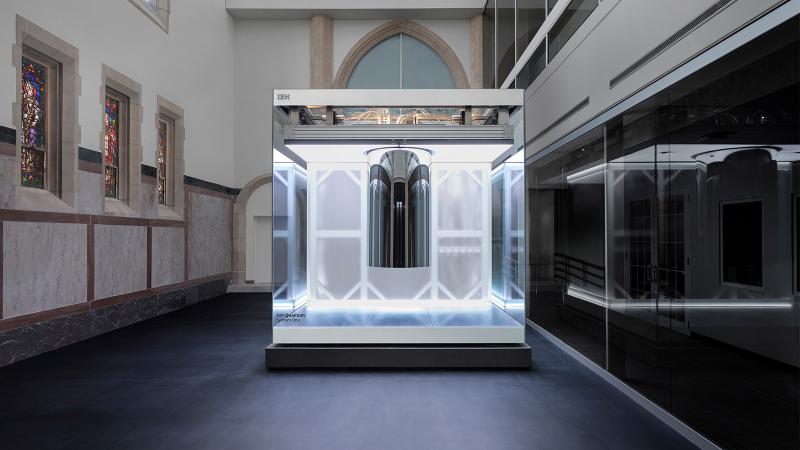
The CCNI system is made up of massively parallel Blue Gene
supercomputers, POWER-based Linux clusters, and AMD Opteron
processor-based clusters, providing more than 100 teraflops of
computing power.
A Web cast of the Sept. 7 colloquy will be archived online.
More information is available at: http://www.rpi.edu/ccni/colloquy
For more information about CCNI, go to:
http://www.rpi.edu/research/ccni
For more information about IBM’s Blue Gene, go to:
http://www-03.ibm.com/servers/deepcomputing/bluegene.html
|
Published
September 7,
2007 |
Contact: Michael Mullaney
Phone: (518) 276-6161
E-mail: mullam@rpi.edu |
|