|
Rensselaer Polytechnic Institute Launches $16.75 Million Center To Research Social Cognitive Networks
Funded by the Army Research Lab, New Center Is
Dedicated to the Emerging Discipline of Network Science and
Will Investigate How Technology Impacts Social
Interaction
Our social networks are staple sources of information,
advice, and ideas. Add technology to the mix — Twitter,
Facebook, cell phones — and the power of social networks
balloons to a global scale. Harnessing that power is the work
of the new Social Cognitive Networks
Academic Research Center (SCNARC) at Rensselaer Polytechnic
Institute.
“Rensselaer offers a unique research environment to lead
this important new network science center,” said Rensselaer
President Shirley Ann Jackson. “We have assembled an
outstanding team of researchers, and built powerful new
research platforms. The team will work with one of the largest
academic supercomputing centers in the world - the Rensselaer
Computational Center for Nanotechnology Innovations - and the
leading visualization and simulation capabilities within our
new Experimental Media and Performing Arts Center. The Center
for Social and Cognitive Networks will bring together our
world-class scientists in the areas of computer science,
cognitive science, physics, Web science, and mathematics in an
unprecedented collaboration to investigate all aspects of the
ever-changing and global social climate of today.”
Joining Jackson to launch the new center today were U.S.
Representative Paul D. Tonko and U.S. Army Brigadier General
Harold J. Greene - who graduated from Rensselaer in 1980. A
scientific session followed opening remarks, with presentations
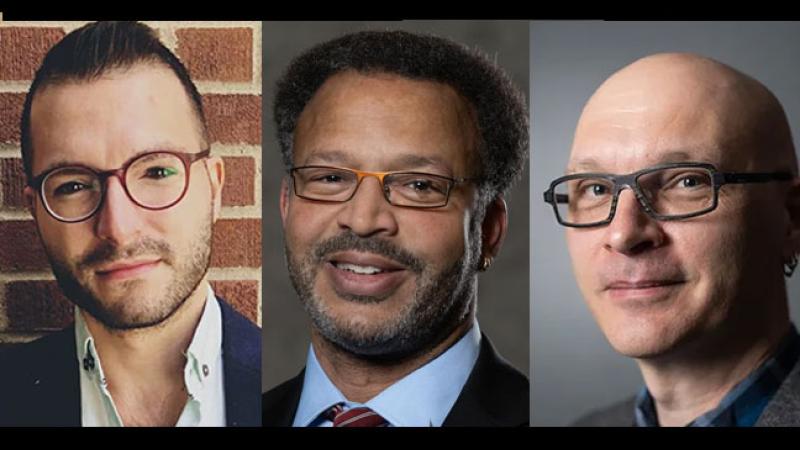
by professors and thought leaders Albert-Làslò Barabàsi of
Northeastern University, Alex Paul Pentland of the
Massachusetts Institute of Technology, Alessandro Vespignani of
Indiana University, and Center Director and Rensselaer
Professor Boleslaw Szymanski.
The new center, funded by a $16.75 million five-year grant
from the Army Research Laboratory, will join researchers from a
broad spectrum of fields — including sociology, physics,
computer science, engineering, and medicine —in exploring
social cognitive networks. The center will study the
fundamentals of network structures and how those structures
have been altered by technology. The goal will be a deeper
understanding of social cognitive networks and a firm
scientific basis for this newly arising field of network
science.
“Social networks involve people who interact for various
reasons - mentoring, friendships, rivalries,” said Szymanski,
the Claire and Roland Schmitt Distinguished Professor at
Rensselaer. “In the past, social networks were limited by the
distance of possible interactions. Thus, they were limited in
size and there was no easy way in which a network could become
huge and fast. Technology — cell phones, Facebook, LinkedIn -
makes it much easier to be involved in the lives of many people
who could be very distant from each other. This brings new
opportunities and new dangers to society.”
The center will look at five aspects of social cognitive
networks, each of which could lead to improvements in how we
form ties, gather information, and make decisions:
-
Dynamic processes: The center will
develop mathematical formulas and models for analyzing the
effects of social cognitive networks, measuring how
interactions influence people performing a task.
“Within every organization, we have relationships between
people who work together — mentors, friends, rivals,”
Szymanski said. “Can we put some measure on, for example, the
impact of mentoring on productivity? Are people with a larger
workplace or a larger social network better at accomplishing
their tasks?”
-
Organizational networks:
Researchers will study how information moves in a network.
All organizations have a hierarchy, but the movement of
information doesn’t always match the established
hierarchy.
“If, as an experiment, you look at records - Web contacts,
cell phone calls — within a large network, you would see
enormous numbers of people interacting. But most interactions
are fleeting. Interactions within a social network are
different because they form the repeat patterns,” Szymanski
said. “Can we get a snapshot of those interactions and trace
some of these connections and look at how people use
technology?”
- Weaving game theory, computer science, and other academic
disciplines leads to better understanding of and ways to
counter the harmful use of adversarial
networks within social networks.
-
Trust within social networks: The
challenge of building trust among a group of individuals with
diverse and opposing perspectives, the fourth aspect, is also
important.
“Often trust arises fastest among people who think
similarly. But how can we build trust among people with
diverse viewpoints?” Szymanski said. “Often, when thinking
includes more viewpoints – the solution is better.”
- · The impact of human cognition on social
networks: In today’s networked society, a decision
maker will always have more data to consider than time in
which to consider it. The new center will develop models to
analyze how human cognitive limitations influence
judgment.
“I want to congratulate the Rensselaer Polytechnic
Institute, the Army Research Laboratory and the other partners
from academia and private industry for collaborating on this
one-of-a-kind venture,” said U.S. Representative Paul D. Tonko.
“The Social Cognitive Network Academic Research Center
represents the cutting edge of creative thinking and research
in a brand new arena which has the potential to initiate
important future discoveries in this field.”
"The growth of RPI is a great success story, not only for
Troy, but for all of upstate New York. I'm extremely proud of
this internationally recognized institution and the outstanding
work they do," said New York State Senator Roy J. McDonald.
“It should be of little surprise to anyone who knows of the
accomplishments and research capabilities of Rensselaer
Polytechnic Institute that they would be called upon to partner
in such groundbreaking research. I want to congratulate
Rensselaer and its scientists on receiving this grant and wish
you great success as with all of the research you are
undertaking,” said Rensselaer County Executive Kathleen M.
Jimino.
“The SCNARC will not only pioneer understanding into the
field of network sciences but is a major addition to the
region’s research and higher education communities,” said Troy
Mayor Harry Tutunjian. “Research, technology, and
businesses in high-tech fields like this are the future of the
Capital Region. Congratulations to RPI for receiving this
prestigious grant and program.”
Rensselaer is the primary member and the leader of a center
with four partners around the country. The Institute is joined
by corporate and academic partners from IBM Corp., Northeastern
University, and the City University of New York, and
collaborators from Harvard University, Massachusetts Institute
of Technology, New York University, Northwestern University,
the University of Notre Dame, the University of Maryland, and
Indiana University.
|
Published
May 4,
2010 |
Contact: Mary L. Martialay
Phone: (518) 276-2146
E-mail: martim12@rpi.edu |
|