|
Researchers at Rensselaer Polytechnic Institute Develop New Method for Mass-Producing Graphene
New, Simple Technique Enables Large-Scale
Production of Graphene at Room Temperature; Researchers Use
Graphene to Build Chemical Sensors,
Ultracapacitors
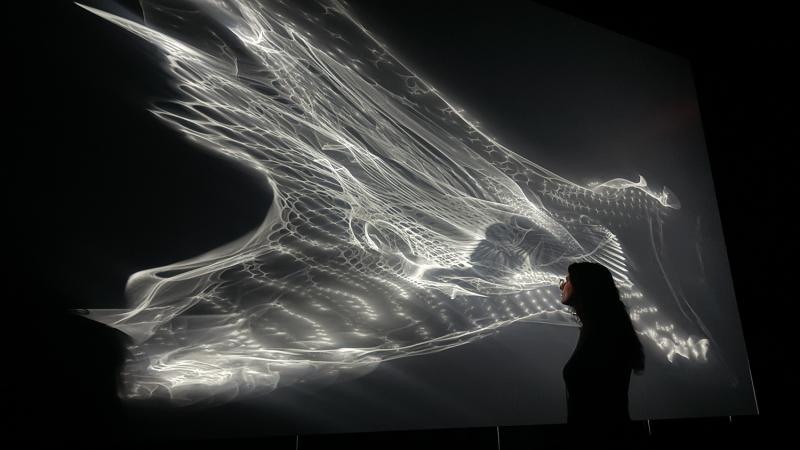
Graphene, as seen in the above
renderings, is an atom-thick sheet of carbon arranged in
a honeycomb structure. It has unique mechanical and
electrical properties and is considered a potential heir
to copper and silicon as the fundamental building blocks
of nanoelectronics, but is difficult to produce in bulk.
A team of Rensselaer researchers has brought science a
step closer to realizing this important goal of a simple,
efficient way to mass-produce graphene. Image Credit:
Rensselaer/Kar
|
A scanning electron microscope image of
the nanomaterial graphene made with a new technique from
researchers at Rensselaer. The new, room-temperature
method needs little processing and paves the way for
cost-effective mass production of graphene. Photo Credit:
Rensselaer/Kar
|
Researchers at Rensselaer Polytechnic Institute have
developed a simple new method for producing large quantities of
the promising nanomaterial graphene. The new technique works at
room temperature, needs little processing, and paves the way
for cost-effective mass production of graphene.
An atom-thick sheet of carbon arranged in a honeycomb
structure, graphene has unique mechanical and electrical
properties and is considered a potential heir to copper and
silicon as the fundamental building block of nanoelectronics.
Since graphene’s discovery in 2004, researchers have been
searching for an easy method to produce it in bulk
quantities.
A team of interdisciplinary researchers, led by Swastik
Kar, research assistant professor in the Department of Physics,
Applied Physics, and Astronomy at Rensselaer, has brought
science a step closer to realizing this important goal. By
submerging graphite in a mixture of dilute organic acid,
alcohol, and water, and then exposing it to ultrasonic sound,
the team discovered that the acid works as a “molecular wedge,
” which separates sheets of graphene from the parent graphite.
The process results in the creation of large quantities of
undamaged, high-quality graphene dispersed in water. Kar and
team then used the graphene to build chemical sensors and
ultracapacitors.
“There are other known techniques for fabricating graphene,
but our process is advantageous for mass production as it is
low cost, performed at room temperature, devoid of any harsh
chemicals, and thus is friendly to a number of technologies
where temperature and environmental limitations exist,” Kar
said. “The process does not need any controlled environment
chambers, which enhances its simplicity without compromising
its scalability. This simplicity enabled us to directly
demonstrate high-performance applications related to
environmental sensing and energy storage, which have become
issues of global importance.”
Results of the study, titled “Stable Aqueous Dispersions of
Non-Covalently Functionalized Graphene from Graphite and their
Multifunctional High-Performance Applications,” were published
online Thursday, June 17, 2010, by the journal Nano
Letters. The study
will also be the cover story of the November print edition of
Nano Letters.
Graphene eluded scientists for years but was finally made in
the laboratory in 2004 with the help of a common office supply
– clear adhesive tape. Graphite, the common material used in
most pencils, is made up of countless layers of graphene.
Researchers at first simply used the gentle stickiness of tape
to pull layers of graphene from a piece of graphite.
Today, graphene fabrication is much more sophisticated. The
most commonly used method, however, which involves oxidizing
graphite and reducing the oxide at a later stage in the
process, results in a degradation of graphene’s attractive
conductive properties, Kar said. His team took a different
route.
The researchers dissolved 1-pyrenecarboxylic acid
(PCA) in a solution of water and methanol, and then introduced
bulk graphite powder. The pyrene part of PCA is mostly
hydrophobic, and clings to the surface of the also-hydrophobic
graphite. The mixture is exposed to ultrasonic sound, which
vibrates and agitates the graphite. As the molecular bonds
holding together the graphene sheets in graphite start to
weaken because of the agitation, the PCA also exploits these
weakening bonds and works its way between the layers of
graphene that make up the graphite. Ultimately, this
coordinated attack results in layers of graphene flaking off of
the graphite and into the water. The PCA also helps ensure the
graphene does not clump and remains evenly dispersed in the
water. Water is benign, and is an ideal vehicle through which
graphene can be introduced into new applications and areas of
research, Kar said.
“We believe that our method also will be useful for
applications of graphene which require an aqueous medium, such
as biomolecular experiments with living cells, or
investigations involving glucose or protein interactions with
graphene,” he said.
Using ultrathin membranes fabricated from graphene, the
research team developed chemical sensors that can easily
identify ethanol from within a mixture of different gases and
vapors. Such a sensor could possibly be used as an industrial
leakage detector or a breath-alcohol analyzer. The researchers
also used the graphene to build an ultra-thin energy-storage
device. The double-layer capacitor demonstrated high specific
capacitance, power, and energy density, and performed far
superior to similar devices fabricated in the past using
graphene. Both devices show great promise for further
performance enhancements, Kar said.
Co-authors on the Nano Letters paper are Rensselaer
Post Doctoral Research Associate Xiaohong An; Assistant
Professor Kim M. Lewis; Clinical Professor and Center for Integrated
Electronics Associate Director Morris Washington; and
Professor Saroj Nayak, all of the Department of Physics,
Applied Physics, and Astronomy; Rensselaer post-doctoral
researcher Trevor Simmons of the Department of Chemistry
and Chemical Biology; along with Rakesh Shah, Christopher
Wolfe, and Saikat Talapatra of the Department of Physics at
Southern Illinois University Carbondale.
The research project was supported by the Interconnect Focus
Center New York at Rensselaer, as well as the National
Science Foundation (NSF) Division of Electrical, Communications
and Cyber Systems.
For more information on Kar’s research, visit his website
at:
For more information on graphene research at Rensselaer,
visit:
|
Published
June 21,
2010 |
Contact: Michael Mullaney
Phone: (518) 276-6161
E-mail: mullam@rpi.edu |
|