|
A Revolutionary Breakthrough in Terahertz Remote Sensing
Unique THz “fingerprints” will identify hidden
explosives from a distance
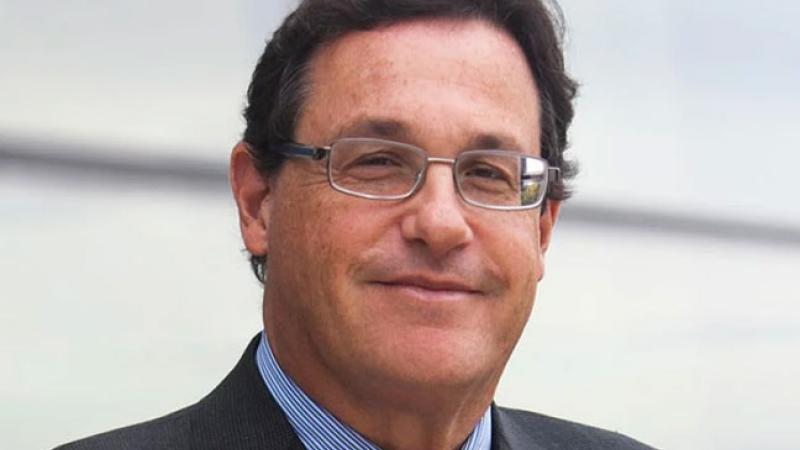
Pictured left to right: Jingle Liu,
Xi-Cheng Zhang, and Jianming Dai. Photo Credit:
Rensselaer/Daria Robbins
|
A major breakthrough in remote wave sensing by a team of
Rensselaer Polytechnic Institute researchers opens the way for
detecting hidden explosives, chemical or biological agents, and
illegal drugs from a distance of 20 meters.
The new all-optical system, using terahertz (THz) wave
technology, has great potential for homeland security and
military uses because it can “see through” clothing and
packaging materials and can identify immediately the unique THz
“fingerprints” of any hidden materials.
Terahertz waves occupy a large segment of the
electromagnetic spectrum between the infrared and microwave
bands, which can provide imaging and sensing technologies not
available through conventional technologies such as X-ray and
microwave.
“The potential of THz wave remote sensing has been
recognized for years, but practical application has been
blocked by the fact that ambient moisture interferes with wave
transmission,” said Xi-Cheng Zhang, director of the Center for
THz Research at Rensselaer.
Zhang, the J. Erik Jonsson Professor of Science at
Rensselaer, is lead author of a paper to be published next week
in the journal Nature Photonics. Titled “Broadband
terahertz wave remote sensing using coherent manipulation of
fluorescence from asymmetrically ionized gases,” the paper
describes the new system in detail.
The “all-optical” technique for remote THz sensing
uses laser-induced fluorescence, essentially focusing two laser
beams together into the air to remotely create a plasma that
interacts with a generated THz wave. The plasma fluorescence
carries information from a target material to a detector where
it is instantly compared with material spectrum in the THz
“library,” making possible immediate identification of a target
material.
“We have shown that you can focus an 800 nm laser beam and a
400 nm laser beam together into the air to remotely create a
plasma interacting with the THz wave, and use the plasma
fluorescence to convey the information of the THz wave back to
the local detector,” said Zhang.
Repeated terrorist threats and the thwarted Christmas Eve
bombing attempt aboard a Northwest Airlines flight heightened
interest in developing THz remote sensing capabilities,
especially from Homeland Security and the Defense Department,
which have funded much of the Rensselaer research.
Because THz radiation transmits through almost anything that
is not metal or liquid, the waves can “see” through most
materials that might be used to conceal explosives or other
dangerous materials, such as packaging, corrugated cardboard,
clothing, shoes, backpacks, and book bags.
Unlike X-rays, THz radiation poses little or no health
threat. However, the technique cannot detect materials that
might be concealed in body cavities.
“Our technology would not work for owners of an African
diamond mine who are interested in the system to stop workers
from smuggling out diamonds by swallowing them,” Zhang
said.
Though most of the research has been conducted in a
laboratory setting, the technology is portable and eventually
could be used to check out backpacks or luggage abandoned in an
airport for explosives, other dangerous materials, or for
illegal drugs. On battlefields, it could detect where
explosives are hidden.
The fact that each substance has its own unique THz
“fingerprint” will show exactly what compound or compounds are
being hidden, a capability that is expected to have multiple
important and unexpected uses. In the event of a chemical
spill, for instance, remote sensing could identify the
composition of the toxic mix. Since sensing is remote, no
individuals will be needlessly endangered.
“I think I can predict that, within a few years, the THz
science and technology will become more available and ready for
industrial and defense-related use,” Zhang said.
Co-authors of the Nature Photonics paper are
Rensselaer’s Jingle Liu, Research Associate Professor Jianming
Dai, and Professor See-Leang Chin of Quebec’s University of
Laval.
|
Published
July 12,
2010 |
Contact: Mark Marchand
Phone: (518) 276-6098
E-mail: marchm3@rpi.edu |
|