|
The New Cultural Form: Perfection versus Mortality in Games and Simulation at Rensselaer
Electronic Artist Ben Chang Joins Rensselaer
Games and Simulation Arts and Sciences
Program
Becoming (2007), Silvia Ruzanka+Ben
Chang, the avatar is one week into the transformation
process. Image by Ben Chang
|
Willy Nilly’s Surf Shack offers a cure for the idealized
virtual world of Second Life. The online shop, a project of
Rensselaer Polytechnic Institute Associate Professor of Arts
Ben Chang and collaborators, endows otherwise flawless avatars
with real-world foils like clumsiness. A project allowing
avatars to visibly age over time is in the works.
The shop is one of several projects Chang uses to explore
humanity in technology. Chang, an electronic artist and
recently appointed co-director of the Games and Simulation Arts
and Sciences program at Rensselaer, sees the dialogue between
perfection and mortality as an important influence in the
growing world of games and simulation.
“There’s this transcendence that technology promises us. At
its extreme is the notion of immortality that — with artificial
intelligence, robotics, and virtual reality — you could
download your consciousness and take yourself out of the
limitations of the physical body,” said Chang. “But at the same
time, that’s what makes us human: our frailty and our
mortality.”
In other words, while the “sell” behind technology is often
about achieving perfection (with a smart phone all the answers
are at hand, with GPS we never lose our way, in Second Life we
are beautiful), the risk is a loss of humanity.
That dialogue and tension leads Chang to believe that the
nascent world of gaming and simulation could become “a new
cultural form” as great as literature, art, music, and
theater.
“This is just the beginning; we don’t really know what this
is going to be, and ‘games and simulation’ is just the best
term we have to describe a much larger form,” said Chang.
“Twenty years ago nobody knew what the Web was going to be.
There was this huge form on the horizon that we were sort of
fumbling toward with different technological experiments,
artistic experiments; I think this is what’s going on with
games and simulation right now.
“There are many things that are very difficult to do
hands-on — it’s very difficult to simulate a disaster, it’s
very difficult to manipulate atoms and molecules at the atomic
level — and this is where simulation comes in handy,” said
Chang. “That kind of learning experience, that way of gaining
knowledge that’s intuitive, that comes through experience and
involvement, can be expanded to many other realms.”
As an electronic artist, Chang’s own work is at the
intersection of virtual environments, experimental gaming, and
contemporary media art.
“I’m interested in what you could call evocative and
poetic experiences within technological systems — creating that
powerful experience that you can get from great music, theater,
books, and paintings through immersive and interactive
simulations as well,” Chang said. “But I’m also interested in
the experiences of being human within technological
systems.”
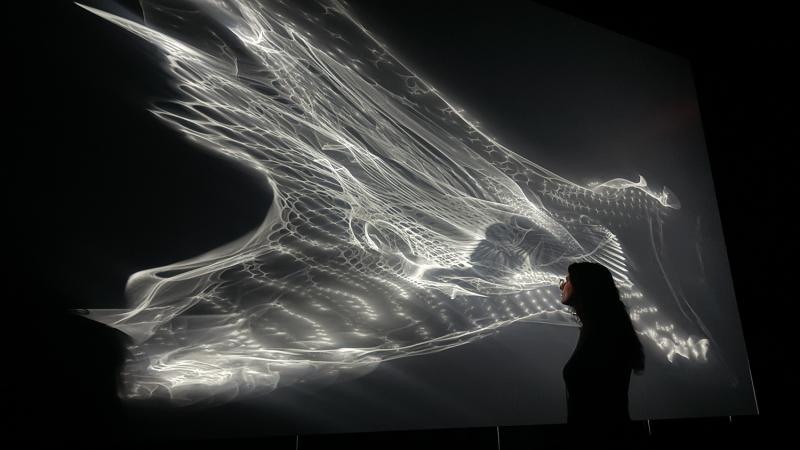
Other recent projects include “Becoming,” a
computer-driven video installation in which the attributes of
two animated figures — each inhabiting their own space – are
interchanged. “Over time, this causes each figure to take on
the attributes of the other, distorted by the structure of
their digital information.”
In “Insecurity Camera,” an installation shown at
art exhibits around the country, a “shy” security camera turns
away at the approach of subjects.
“What I’m interested in is getting at those human qualities
that are still there,” Chang said. “Some of this has to do with
frailty, with fumbling, weakness, and failure. These are things
that can get disguised, they can get swept under the rug when
we think about technology.”
Chang earned a bachelor of arts in computer science from
Amherst College, and a master of fine arts in art and
technology studies from the Art Institute of Chicago. His
installations, performances, and immersive virtual reality
environments have been exhibited in numerous venues and
festivals worldwide, including Boston CyberArts, SIGGRAPH, the
FILE International Electronic Language Festival in Sao Paulo,
the Athens MediaTerra Festival, the Wired NextFest, and the
Vancouver New Forms Festival, among others. He has
designed interactive exhibits for museums such as the Museum of
Contemporary Art in Chicago and the Field Museum of Natural
History.
Chang teaches a two-semester game development course that
joins students with backgrounds in all aspects of games —
computer programming, computer science, design, art, and
writing — in the process of creating games. The students start
with a design, and proceed through all the steps of planning,
creating art work, writing code, and refining their game.
“Think of it as a foundation into developing games that you
can take into experimental game design and stretch beyond it,”
Chang said.
As the “new cultural form” evolves, Chang sees ample room
for exploration.
For example, said Chang, virtual reality, in which
experiences are staged in a wholly digital world, leads to
different implications than augmented reality, in which digital
elements overlay the physical world. One implication of virtual
reality – in which, as in Second Life, users can experiment
with their identity — lies in research which suggests that
personal growth gains made within the virtual world transfer to
the real world. One implication of augmented reality — in which
users may add digital elements that only they can access — is
the possibility of several people sharing the same physical
world while experiencing divergent realities.
In the near term, the most immediate implications for the
emerging form are, as might be expected, in entertainment and
education.
“What’s already happening is this enrichment of the notion
of what entertainment is through games,” Chang said. “When you
talk about games, you often have ideas of simple first-person
shooter or action games. But within the realm of entertainment
is an immense diversity of possibilities — from complex
emotional dramatic story-based games to casual games on your
cell phone. There’s this range of ways of playing from
competitive, multiplayer, social to creative. This is just
within the entertainment realm.”
The Rensselaer Games and Simulation
Arts and Sciences (GSAS) program has been named among the
top 15 out of 150 undergraduate game design programs in the
United States and Canada, according to a new survey from the
Princeton Review. The program offers a comprehensive
understanding of interactive digital media, a balance of
disciplinary competencies, and the mastery of a self-defined
set of interrelated disciplinary challenges.
|
Published
April 18,
2011 |
Contact: Mary L. Martialay
Phone: (518) 276-2146
E-mail: martim12@rpi.edu |
|