|
A Walk Through the Nervous System: Artists’ View of Nerves and Spinal Cord Injury at Rensselaer Polytechnic Institute
Rensselaer Biomedical Engineers Team Up With
College of Saint Rose, Capital Region Artists To Teach Visitors
About Nerves and Spinal Cord Injury Through
Art
A large challenge for scientists and engineers is generating
public awareness and understanding of their research. Several
biomedical engineers at Rensselaer Polytechnic
Institute have collaborated with artists from the College
of Saint Rose and the surrounding Capital Region to bring their
research on healing the nervous system to the public through
art.
The first workshop exhibition of their collaboration will be
open to the public on May 11, from 3:30 p.m. to 6 p.m. with
guided tours occurring at 3:30 p.m. or 5 p.m. in the Center for Biotechnology and
Interdisciplinary Studies at Rensselaer. Between the tours
will be an exhibit symposium from 4:15 p.m. to 4:45 p.m. to
discuss the future of the collaboration, which is being funded
in part by the National Science Foundation.
The exhibit focuses on the research being conducted in the
laboratories of two members of the Department of Biomedical
Engineering at Rensselaer: Assistant Professor Guohao Dai and
Assistant Professor Ryan Gilbert. The
creation of the artistic works was led by Visiting Assistant
Professor of Art at Saint Rose, G.E. Washington. Washington was
joined in the creation of the artistic works in the exhibit by
Professor Kristine Tolmie, Amy Pollicino, Juan Ramos, Jason
Cosco, and Saint Rose graduate assistants Melinda Crowther and
Chris Skaggs. Several Rensselaer graduate students in the
Biomedical Engineering Department have assisted in
communicating the science to artists and in organizing the
exhibit, including Courtney Dumont, Dianna Kim, Abby Koppes,
Ryan Koppes, Anna Lorenz, Chris McKay, Nick Schaub, and Scott
Wentzell.
“We really want to use this collaboration as a way to
interest younger students in our research and educate the
public on the devastating results of spinal cord injury,” said
Gilbert. “We reached out to the artists because we felt art
would be a very good way to relate the complexity of the human
nervous system to things people can better understand.”
On May 11, the artists and their students will be setting up
three different displays for discussion. The works are focused
on Gilbert and Dai’s research into stem cell technologies and
the healing of spinal cord injuries. Each of the works is
artistic and scientific as well as educational, according to
the collaborators.
“The cells of our nervous system are a tiny, tiny world,”
Washington said. “These cells are things that people can’t
imagine. We are trying to give people a personal and direct
connection with that tiny, tiny world of the nervous
system.”
The works include a large inflatable sculpture of the
ganglion knot, which is a mass of interconnected nerve cells
that communicate with each other in highly complex ways within
our nervous system. The large sculpture depicts the manner in
which the cells of the ganglion communicate with each other.
This represents a major portion of the Rensselaer researchers’
work to understand and rebuild the connections between damaged
nerve cells.
A separate work represents how nerve cells respond when they
are injured such as when the cells in the spinal cord are
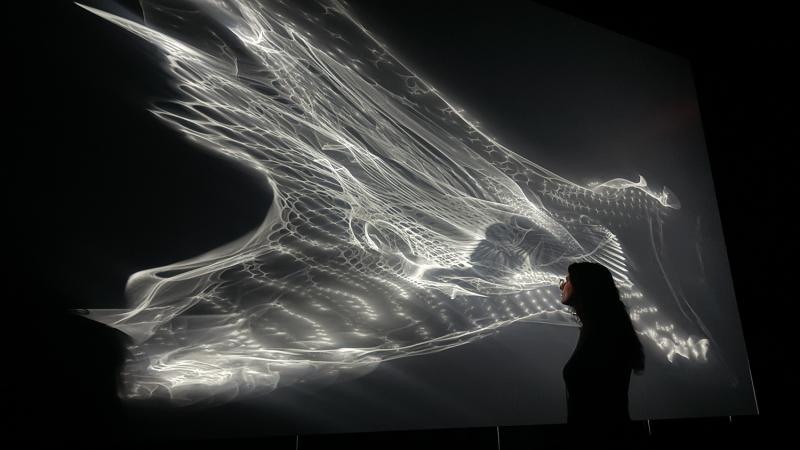
damaged in an injury. The work involves projection of light and
pictures to convey the effects of injury to a damaged nerve
cell. Gilbert is working in his lab to develop biomaterials
that help heal spinal cord injuries.
The final piece allows visitors to walk around a human-scale
and three-dimensional version of a human spinal cord cell
called an astrocyte. The work is done using beautifully printed
and folded reams of paper, taking the two-dimensional versions
of the cells the researchers look at on microscope slides and
bringing it to life for the viewer, according to Washington.
The paper also serves to represent the delicacy of the nervous
system.
Those planning to attend the exhibit should contact
Washington directly at garnellwashinton@yahoo.com
to confirm their attendance.
For more information on Dai’s research go to: http://faculty.rpi.edu/node/1116
For more information on Gilbert’s research go to: http://www.rjgilbertlab.com/
Both scientists are members of the Center for Biotechnology
and Interdisciplinary Studies at Rensselaer.
|
Published
May 2,
2012 |
Contact: Gabrielle DeMarco
Phone: (518) 276-6542
E-mail: demarg@rpi.edu |
|