January 23, 2026
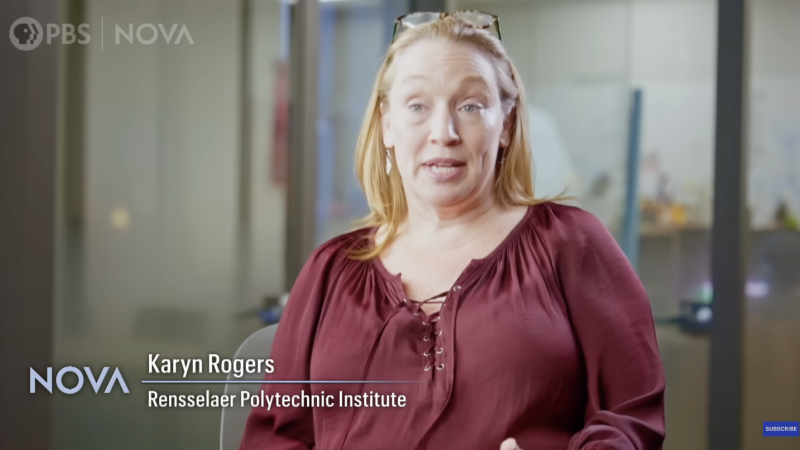
RPI Professor Karyn Rogers, director of the Rensselaer Astrobiology Research and Education Center, and graduate student Meri Herrero Perez are among the feature interviewees in the new PBS NOVA documentary Asteroids: Spark of Life?
The documentary explores the theory that asteroid impacts provided the essential ingredients — water, minerals, and energy — needed for life to emerge on Earth.
Rogers studies the origins of life on Earth, and the potential for life elsewhere in the galaxy. Her lab recreates the conditions on Earth during the Hadean Eon, spanning roughly 4.6 to 4.0 billion years ago. She also studies how modern-day deep-sea hydrothermal vents mimic some of those early-Earth conditions. Herrero Perez' work examines interactions between asteroid-derived materials and planetary environments.
"In some ways, the early Earth was a big experimental laboratory doing prebiotic chemistry," Rogers explains in the documentary. "We can do experiments that were similar to what the early earth was doing and hopefully discover the chemistry that eventually led to life."
Herrero Perez explained her work on some of those experiments, and how they showed evidence of more complex interactions than scientists had previously suspected. "The first time I saw the result of a successful experiment, I did not believe what I was seeing," she said. "I thought that I had done it wrong. And then I spoke with Karyn, and we could understand that there was more complex chemistry happening than we envisioned."
The documentary is currently available on the PBS website and on YouTube.