May 13, 2026
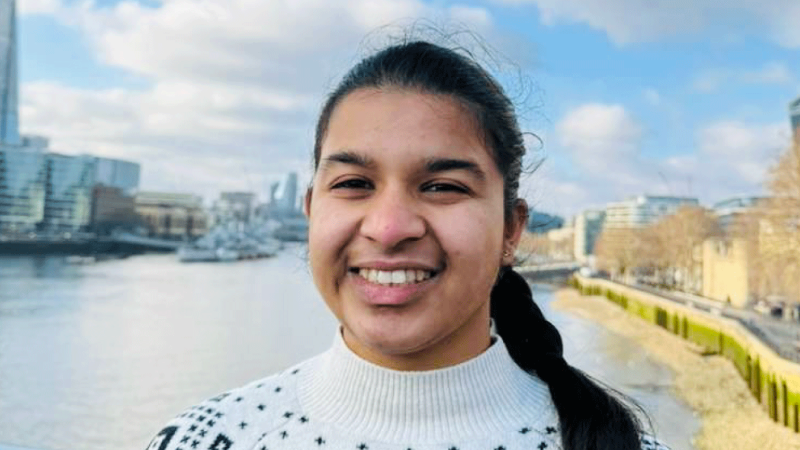
By Jayashree Balaraman ’26, dual major in computational biology and biochemistry
As a child, I was always asking questions. I was the kid who loved mad-science camps, fascinated by the idea that the world could be understood if you kept asking "why?" and “how?”. My high school math teachers Mrs. Raisa Berkovich and Mrs. Maria Cisnero taught me to see learning as not just acquiring knowledge, but as a way to think deeply and to create and contribute meaningfully. That spirit of curiosity would eventually set me on a path toward one of medicine's most pressing challenges: cancer diagnostics and treatment.
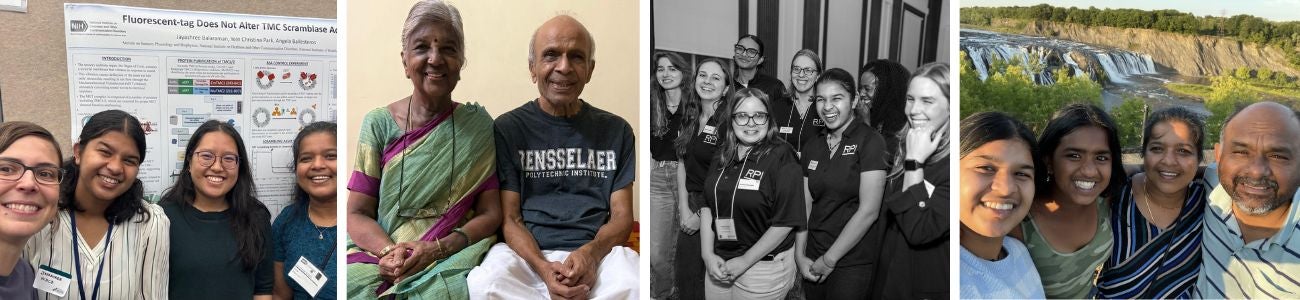
At RPI, I had the opportunity to explore this path. Starting in my sophomore year – and for three years after that – I worked in the Hurley Lab studying circadian rhythms through a multi-OMICs and computational lens. What began as an interest in biology became a deeper appreciation for how much remains hidden beneath the surface, and how modeling and simulation can help uncover it. That realization became the foundation of how I think about disease, by seeking to understand complex biological systems to uncover mechanisms.
My path became even clearer when earlier this year, I lost my grandmother to late-stage esophageal cancer. While my interest in biology and disease had long been present before this loss, it gave my work a new sense of urgency. It pushed me to think more broadly about the challenges in medicine – not only how we detect disease earlier, but how we intervene more effectively. From diagnostics to therapeutic delivery, there is a need for approaches that are precise, accessible, and capable of reaching patients at the right time. The experience also reinforced my belief that science matters most when knowledge is translated into real-world impact.
Throughout this experience, and all my years here, I could always count on the RPI community. Working with mentors like Professor Lee Ligon, Emily Killian, and Sharleen Buel taught me to see science as a shared responsibility, where collaboration is essential to turning discovery into better outcomes for patients. I learned that collaboration and community are what allow new ideas and interdisciplinary thinking to thrive in science.
Outside the lab, I served as a resident assistant, competed in cricket tournaments as a leg-spinner, and was part of organizations like Science Ambassadors, the Women at Rensselaer Mentoring Program, and the biological honor society Beta Beta Beta – each shaping the scientist I am and the sense of purpose I bring to my work.
My parents, my dearest grandparents Radhai, Sathyam, and my sister Divya have been my foundation, encouraging and supporting me every step of the way.
As I move forward to pursue a Ph.D. in Computational and Systems Biology, I carry forward my grandmother’s legacy. Watching her face a late-stage diagnosis showed me exactly what is lost when detection comes too late. I intend to dedicate my career to understanding the mechanisms behind cancer and improving diagnostics/therapeutics for all.