March 31, 2026
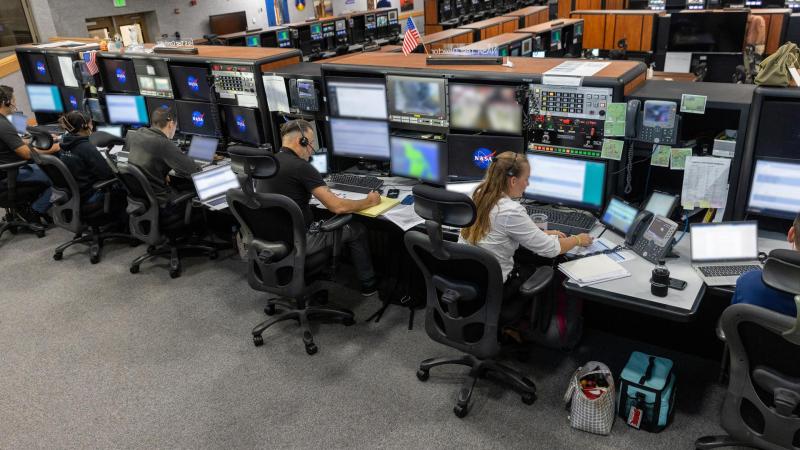
When Reid Wiseman '97 straps into the Orion capsule as commander of Artemis II, NASA's first crewed lunar mission in more than half a century, he won't be the only RPI alum with a stake in the flight. At Johnson Space Center, a new generation of RPI engineers will be watching, calculating, and guiding, performing critical earthbound tasks to ensure a successful voyage for the craft and crew.
Two of those engineers are Maeve Marshall '23, M.Eng. '24, and Paul McKee '17, MS '18, Ph.D. '23, who joined NASA's Johnson Space Center in the last few years. Their work sits at the heart of one of the mission's most technically demanding challenges: figuring out, in real time, exactly where the spacecraft is and how it's oriented.
At the Console
Marshall, just over a year into her career, is supporting what's known as the MER RPOD console — Mission Evaluation Room, Rendezvous, Proximity Operations, and Docking. In plain English, she's part of the team tracking how Orion approaches and eventually docks with other spacecraft. She's also spent months writing the software tools that engineers will use during the flight itself.
"The shortest I could probably pare the job down to," she says, "is software development and mission support for the docking camera during the Artemis II flight."
That camera is flying for the first time. It wasn't aboard Artemis I, and no amount of simulation can fully substitute for the real thing. "We have a number of questions about how the camera will perform in real life," Marshall explains. "You can't sim everything. That's the whole objective of Artemis II for us, to figure out what we can expect from the camera going forward to actually docking during Artemis III."
McKee, meanwhile, works on the Orion Optical Navigation team, where cameras do double duty as both compass and map. "We can identify patterns of stars in a star field image and solve for the camera pointing direction," he explains. "In that way a star field image serves the role of a compass, giving us orientation." Images of the Earth and Moon, he adds, allow the team to "determine our distance and direction from their apparent size and location in the image, giving us a 3D position in space."
Like Marshall, McKee will be in the MER during the flight, headset on, ready to support flight controllers if something unexpected occurs. "The Flight Operations Directorate 'drives' the spacecraft during the mission," he says, "but they look to the nerds in the back room — me and my friends — if something starts to act funny."
Putting it All Together
Ask either engineer about their biggest technical challenge, and a common theme emerges: integration. Not the calculus kind, but rather the human, organizational, everything-has-to-talk-to-everything-else kind.
"There are a million pieces that all have to work together in order for everything to work,” Marshall says. “The Artemis mission is pretty complex, and I feel as though I've been drinking from a fire hose trying to keep up."
McKee echoed the fire hose metaphor. "Even though I helped write this software, it takes a completely different mindset to help operate it," he said. “It's like the difference between learning anatomy and physiology in a textbook and helping a patient in a hospital."
For McKee, one of the personal highlights of the mission will be the first live test of an attitude-determination algorithm called imgAtt — short for image attitude — that his team developed. "I spent a lot of time working out the kinks of that program," he says, "and I am elated to be the one who sits on console for the first test run."
What RPI Gave Them
Both engineers point to specific RPI coursework as foundational.
For McKee, the most valuable course wasn't one of the big-name requirements, but a special topics class in spacecraft navigation taught by Professor John Christian in spring 2018. "That course isn't offered anymore," he notes, "but the closest thing to it is MANE 4964/6964, 'Introduction to Spacecraft Navigation,' which I taught in spring 2024 and spring 2025, and I intend to teach again in spring 2027." He also draws daily on MANE 4100 Spaceflight Mechanics and the systems engineering principles from MANE 4250 Space Vehicle Design.
Marshall's answer goes straight to the fundamentals: "Data Structures," she says. "Hands down. I am still waiting for a day to come that I don't get to apply something that I learned in that class. Something like 14 months in now and that hasn't happened yet. Huge props to those professors."
A Tradition of Spaceflight
McKee puts his work on the mission in historical context. "My work at NASA is just the latest in a long line of RPI-NASA collaboration," he says. "RPI has at least three astronauts among its alumni, including Reid Wiseman, and George Low, RPI grad and former President, was the head of the Apollo program."
That history is visible, literally, on campus. McKee encourages students to visit the George Low Gallery in the CII building. And to students finding the RPI workload daunting, he offers a message earned the hard way: "RPI can be very challenging, and the work can even be discouraging at times, but don't lose heart! Keep on keeping on."