April 13, 2026
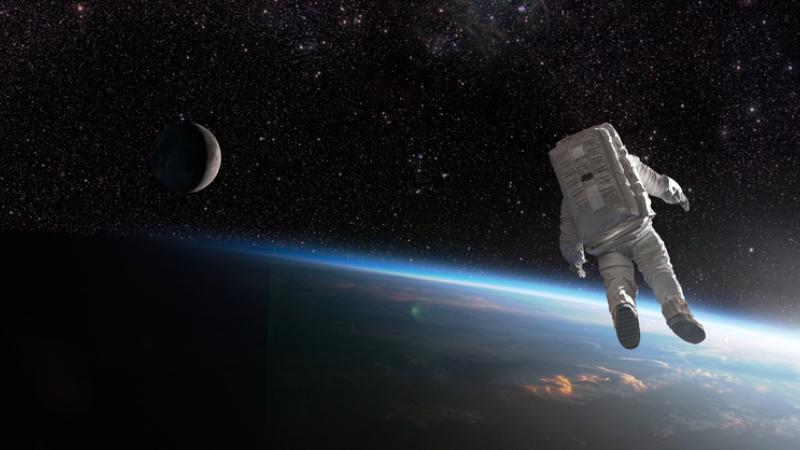
When Reid Wiseman ‘97 strapped into the Orion spacecraft in April for humanity's first lunar voyage in more than half a century, he carried with him not just the hopes of a new generation of space explorers, but the legacy of the first technological research university — one that has quietly shaped America's journey to the cosmos.
Wiseman, a graduate of Rensselaer Polytechnic Institute (RPI), commanded the Artemis II mission — a ten-day journey that sent four astronauts around the Moon, farther than any human being has ever been from home. The mission was a homecoming of sorts for RPI, an institution whose fingerprints can be found on nearly every major milestone of the Space Age, from the first footsteps on the Moon to the rovers trundling across Mars.
Wiseman's path from Troy to the stars followed a well-worn trajectory. After earning his degree in computer and systems engineering, Wiseman joined the Navy, became a test pilot, and was selected as an astronaut by NASA in 2009. During his 2014 stint aboard the International Space Station, he captivated more than half a million social media followers with photos and musings about the profound experience of seeing Earth from orbit. "My very first thoughts after getting into orbit and having a look at our planet below were — no photo does this justice, and every single person should get to come see this for themselves," he said.
Now, as Artemis II commander, Wiseman represents the latest chapter in a story that began more than six decades ago, when another RPI graduate found himself at the center of humanity's most audacious technological endeavor.
The Man Who Saved Apollo
If Reid Wiseman is the public face of RPI's return to the Moon, George M. Low was the engineer who made the first journey possible, though his name rarely made headlines.
Low arrived at RPI in 1943. He studied under Paul E. Hemke, founder of RPI’s aeronautical and metallurgical engineering program, and experimented in the basement of the Ricketts Building in the department’s first wind tunnels and engine testing lab. “Whatever I accomplished at NASA or contributed to the space program, really began right here at RPI,” Low said. He went on to receive a master’s degree at RPI and in 1958, when NASA was formed, became the new agency’s first chief of manned spaceflight.
Low's defining moment came in the aftermath of tragedy. On January 27, 1967, a flash fire during a launch test killed three Apollo 1 astronauts — Virgil Grissom, Ed White, and Roger Chaffee. The disaster exposed fundamental flaws in the spacecraft design and threatened to derail President Kennedy's promise to land Americans on the Moon before decade's end.
NASA turned to Low to resurrect the program. As manager of the Apollo Spacecraft Program Office, he led a grueling redesign effort that involved working ninety-hour weeks for more than a year and a half. Low and his team disassembled all two million parts of the command module, uncovering a catalog of potentially fatal problems: faulty wiring, malfunctioning switches, and inadequate backup systems.
By December 1968, Low had declared the spacecraft flight-worthy and made a bold proposal: send the first crewed Apollo mission all the way to lunar orbit, ahead of schedule. Apollo 8 circled the Moon during Christmas week of 1968, sending back the iconic "Earthrise" photograph and setting the stage for Apollo 11's landing seven months later. NASA Administrator James Fletcher would later write: "Without George Low in exactly the places he occupied at NASA, the United States would not have been able to land men successfully on the Moon."
Low went on to serve as NASA's deputy administrator and acting administrator before returning to RPI as its president in 1976, a position he held until his death in 1984, one day after being awarded the Presidential Medal of Freedom.
From Apollo 13 to the Space Shuttle
RPI's contributions to space exploration extended beyond Low's leadership. John "Jack" Swigert Jr., who earned his master's degree from RPI in 1965, became an Apollo astronaut that same year. His moment of fame came on April 13, 1970, when an oxygen tank exploded aboard Apollo 13, forcing the mission to abort its lunar landing. Swigert, the command module pilot (portrayed by Kevin Bacon in the 1995 film), helped guide the crippled spacecraft on a dramatic "slingshot" trajectory around the Moon and back to Earth, a journey that paradoxically took the crew farther from home than any humans before or since.
The post-Apollo era saw RPI alumni continue to push boundaries. Richard "Rick" Mastracchio ‘87 became one of NASA's most experienced spacewalkers, logging nine spacewalks totaling more than 53 hours outside the spacecraft. His missions included critical assembly and repair work on the International Space Station, the orbital laboratory that has hosted continuous human presence in space for more than two decades.
The Red Planet Connection
While RPI's astronauts captured public imagination, an equally significant contingent of alumni helped extend humanity's reach to Mars. When the Spirit and Opportunity rovers landed on the Red Planet in 2004, more than a dozen RPI graduates were involved in various aspects of the mission.
Kobie Boykins ’96 became a senior mechanical engineer at NASA's Jet Propulsion Laboratory and played key roles in designing three Mars rovers. Frederick Serricchio ‘94 served as the attitude control system engineer for cruise and entry, descent, and landing. Michael Meyer ’74 rose to become the lead scientist for NASA's entire Mars Exploration Program.
The tradition continues with newer missions. Bob Balaram, M.S. '82, Ph.D. ‘85, served as chief engineer for the Ingenuity Mars helicopter that made the first powered flight on another planet in 2021. The roots of all their work stretch back decades earlier, when an RPI prototype of a Mars rover was featured on Carl Sagan’s Cosmos.
Back to the Moon
Reid Wiseman may be the most visible RPI alum on the Artemis mission but he’s far from the only one. Several RPI engineers worked the control room of the mission, testing and monitoring critical tools ensuring the safety of the crew. Many others are employed in various roles in NASA and other space agencies.
RPI’s influence lies, in part, in its founding mission. Established in 1824 as the first technological research university in America, the university has long emphasized practical problem-solving and systems thinking, the type of skills needed for the complex challenges of spaceflight.
That interdisciplinary approach proves essential in modern space exploration, where success depends on integrating mechanical, electrical, software, and human systems into seamless wholes. It's the same systems-level thinking that George Low brought to Apollo's redesign and that Reid Wiseman will bring to Artemis II.
As Wiseman and his crewmates return from Earth's orbit, they're following a path blazed by their predecessors from Troy: engineers who believed that the hardest problems were worth solving, that setbacks could be overcome through meticulous work, and that humanity's reach should always exceed its grasp.