How Convincing Is New Evidence for Past Life on Mars? A Q&A with RPI's Karyn Rogers
An astrobiology researcher discusses new evidence for past life on Mars
Rensselaer is part of NASA’s new Prebiotic Chemistry and Early Earth Environments (PCE3) Consortium,one of five cross-divisional research coordination networks with the NASA Astrobiology Program. The PCE3 aims to identify planetary conditions that might give rise to life’s chemistry.
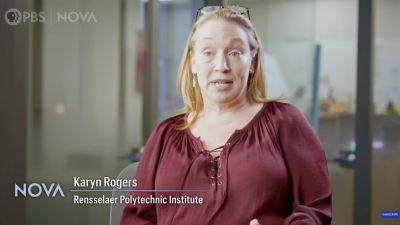
NASA’s Astrobiology Program has awarded a $9 million grant to Earth First Origins project, led by Rensselaer Polytechnic Institute Assistant Professor Karyn Rogers, to uncover the conditions on early Earth that gave rise to life by identifying, replicating, and exploring how prebiotic molecules and chemical pathways could have formed under realistic early Earth conditions.
A natural “battery” of briny liquids and volcanic minerals may have produced Mars’ organic carbon, according to new analysis of three Martian meteorites by a team including researchers at Rensselaer Polytechnic Institute.
Where did life begin—in a shallow lagoon, or in a vent of superheated water spewing from the ocean floor? If we knew, we might know where to look for life elsewhere in the universe.
Karyn Roger has been appointed as an assistant professor in the Department of Earth and Environmental Sciences.