Ge Wang Receives 2021 EMBS Academic Career Achievement Award
Ge Wang, the Clark and Crossan Endowed Chair professor of biomedical engineering at Rensselaer Polytechnic Institute, has received the 2021 EMBS Academic Career Achievement Award.
Carla Leitao, a lecturer in the School of Architecture at Rensselaer Polytechnic Institute, has been invited to present work at “CityX Venice,” the 17th Venice Architecture Biennale Italian Virtual Pavilion, curated by Tom Kovac from RMIT University in Australia and Alessandro Melis of the University of Portsmouth in England.
The U.S. Food and Drug Administration has approved a new drug for treating schizophrenia and bipolar I disorder that includes samidorphan, a new chemical entity discovered at Rensselaer Polytechnic Institute.
The future of quantum computing may depend on the further development and understanding of semiconductor materials known as transition metal dichalcogenides (TMDCs). These atomically thin materials develop unique and useful electrical, mechanical, and optical properties when they are manipulated by pressure, light, or temperature.
Jim Malazita, an assistant professor in the Department of Science and Technology Studies with an appointment in the Games and Simulation Arts and Sciences program at Rensselaer Polytechnic Institute, has been awarded a fellowship from The Strong, a museum based in Rochester, New York, devoted to the history and exploration of play.
Faculty members from the School of Engineering recently received four of the prestigious annual Institute Awards.
More strategic and coordinated travel restrictions likely could have reduced the spread of COVID-19 in the early stages of the pandemic. That’s according to new research published in Communications Physics. This finding stems from new modeling conducted by a multidisciplinary team of scientists and engineers at Rensselaer Polytechnic Institute.
Most everyone has heard about the dangers of lead — a toxic metal used for centuries that, because of mining, industrial pollution and automobile emissions, is found in the soil of playgrounds, parks, empty lots, and maybe even your backyard. Remediation or removal is expensive and nearly impossible in many situations. So how can people try to reduce the harms caused by lead in the soil of their communities?
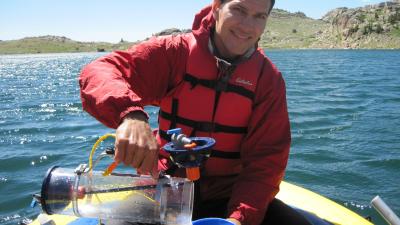
Oxygen levels in the world’s temperate freshwater lakes are declining rapidly — faster than in the oceans — a trend driven largely by climate change that threatens freshwater biodiversity and drinking water quality.
The COVID-19 pandemic has exacerbated inequities in urban freight and the delivery of goods. This misalignment in the supply chain is perpetuating food insecurity, especially in areas where grocery store access is limited or non-existent and for those who have limited access to e-commerce.